DemoCampGuelph10 is happening on Wednesday July 15 from 6:30pm–9:00pm. I demonstrated Primal Fusion’s thought networking service at the last edition of GuelphDemoCamp, and enjoyed the great questions and feedback. I’m looking forward to this edition and the opportunity to just enjoy what others are showing without thinking about my own demo. As with the last edition, the venue is eBar at 41 Quebec Street.
Ten thoughts on what matters at a startup: Balance
Why does balance matter at a startup?
There can’t be a large number of people who looked back on their life from their death bed and said “I wish I had spent more time at the office”. It’s important to maintain some balance between work and the rest of your life. Even if you’re lucky enough to love your work, which is almost certainly the case if you’re working at a startup, being able to get away from it and do other things will help reduce stress. Moreover, you’ll also get a little distance from pressing problems, which can help you see them in a different way and even discover solutions.
It’s also important to maintain some balance between the perspectives of the various stakeholders that matter to your startup. To achieve a balance, you need to understand your customers, your users, your team mates, and your investors. Critically, you need to understand yourself and why you’re doing this. Without balance, your customers can pull you in a direction that isn’t strategically important to your company, or your users can push for features that add more clutter than value, or you can push for features that your team mates know are extremely costly to implement. Balancing the various perspectives will help keep you on track.
This is one in a short series of posts called Ten Thoughts on what matters at a startup. The thoughts started life as a presentation I made at VeloCity residence at the University of Waterloo. While they’re far from definitive, and aren’t a top ten, they’ve mattered to me in my software startup experience.
On the Grand River Trail at RIM Park


One of the great things about living in Waterloo is the cycling opportunities.
One of my favourite routes includes the portion of the Grand River Trail that winds its way through RIM Park. The trail is paved, which makes it ideal for people walking, roller blading, cycling, or pushing baby strollers, all of whom easily co-exist on the trail. Apparently there are even horses, based on the “deposits” that I saw on a recent visit! The trail includes plenty of places to stop and enjoy the view of the river.
While I mainly cycle the trail on my own, my kids have enjoyed riding and walking the trail as well. The pace is little slower when we use the trail as a family!
Canada designs, builds, and shares
Today is the July 1 Canada Day holiday where I live. In a departure from the bulk of my posts, I’ll celebrate, in a small way, Canadian achievements based on the design/build/share theme of this blog.
Design: Not only did Canadians at de Havilland Canada design the DHC-2 Beaver, they also built hundreds of examples of it for use around the world. It’s arguably the greatest bush plane ever, and even has the distinction of appearing on a 1999 commemorative Canadian 25-cent piece. That’s distinct from the beaver that appears on our 5-cent piece!
Build: We build a lot of things, and do it well. One that’s close to home for me is the Toyota Corolla. Yes, it’s a Japanese car, but thousands of them have been assembled just down the road from Waterloo, in Toyota’s Cambridge plant, and the build quality is outstanding. Corollas are built to last; my family’s is 12 years old and still going strong.
Share: The Perimeter Institute of Theoretical Physics here in Waterloo exists because Mike Lazaridis, co-founder and co-CEO of RIM (makers of the Blackberry), decided that he wanted to share his wealth by funding basic research. He supplied a large seed in the form of $100 million. The result, with a lot of help from others, of course, is a world-class research facility. It’s not the only example of his sharing, but it’s one from which I get direct benefit as a result of living here in Waterloo.
Ten Thoughts on what matters at a startup: Help
Why does help matter at a startup?
At a startup there’s a lot to do, you’re under-resourced, and you’re all in it together. You’ll need help from your team and they’ll need help from you.
“That’s not my job” is not something that anyone wants to hear when a milestone is looming. “How can I help?” has a much better ring to it, and is much more likely to lead to success at a startup. Having said that, knowing your own limitations is fine. A willingness to help is what’s important.
One of my favourite emails at Primal Fusion came in the days after we launched our product at DEMO. The influx of users led, inevitably, to issues that needed to be addressed. My manager and I dived into answering emails from users who encountered problems. We had good fun, and at one point he sent me this email: “All these years of professional services and you and I have finally been promoted to help desk ;)”
I’m pretty proud of that, even though it really had little to do with my job.
Finally, two things to keep in mind regarding your willingness to help. First, help isn’t about stepping all over your team mates. Remember, “How can I help” is a question to ask, not a directive to interfere. Second, make sure that the work you’re actually accountable for gets done, or negotiate something else.
This is one in a short series of posts called Ten Thoughts on what matters at a startup. The thoughts started life as a presentation I made at VeloCity residence at the University of Waterloo. While they’re far from definitive, and aren’t a top ten, they’ve mattered to me in my software startup experience.
Sherwood Forest Incorporated
In my second post for this blog, I wrote about The Dam Busters and how that movie provides a fine metaphor for a startup company. I recently re-watched another favourite movie, 1938’s The Adventures of Robin Hood with Errol Flynn in the title role. The parallels with a startup company jumped out at me, and here’s the resulting movie-as-metaphor post.
The Adventures of Robin Hood features a visionary founder (Robin of Loxley) with an innovative and disruptive idea (stealing from the rich to give to the poor) to solve a pressing problem (the oppression of the people by Prince John and his cohorts). There are co-founders (Little John, Friar Tuck, and a few others) who support Robin through the hard work (freeing various peasants, retrieving ill-gotten gains) of proving that his idea will work.
Having successfully launched his startup company (his band of merry men), Robin goes to market (larger scale interference with the Prince’s nefarious looting of the countryside) and builds a loyal following (more merry men and supporters) who buy into his vision (now expanded to include freeing King Richard from a foreign prison).
Robin’s success as a leader (his followers have clarity on his vision and work hard to deliver on it) makes the merry men a great success (they even steal from Guy of Gisbourne and the Sherriff of Nottingham). Their competitors strike back (capturing Robin during an archery contest) but Robin’s team perseveres (rescuing Robin in dramatic fashion) and build on their lead in the market.
Robin and his men continue to work hard and when an unexpected opportunity arises (King Richard returns to England and finds Robin) he capitalizes on it (executes a plan that restores Richard to the throne in place of Prince John) to decisively win the marketplace.
Robin steps aside as CEO and turns over his company to an experienced executive (King Richard) while negotiating a great payoff for his team (pardons all around for the merry men). As founder, he is amply rewarded (various new titles from Richard) and retires (to marry Lady Marian).
The movie is loads of fun, if you like this sort of thing (which I do).
June UX Group event is on Thursday
The June meeting of the UX Group of Waterloo Region is happening at 5:00pm on Thursday June 25 at the Accelerator Centre. This month it’s a presentation by Qixing Zheng called From Concept to Production: Prototyping with Expression Blend 3. The event is hosted by the Infusion Angels Innovation Centre and registration is required.
The solace of a Quantum To Cosmos festival
I’ve written before about lectures that the Perimeter Institute puts on here in Waterloo. Their public outreach program is a wonderful part of life in Waterloo. Science, fun, and accessible? PI has it covered. They’ve recently announced Quantum To Cosmos: Ideas for the Future, an amazing 10-day festival to be held next October. The mix of science and the arts is quite inspiring to see, and I’m excited about this even though it’s four months away.
I’m particularly lucky as PI is walking distance from my home — not everyone has that luxury. Everyone in Waterloo region does have access to PI and this festival, though, and living and working in here is strikingly enhanced as a result. Thanks, PI!
Why work at Primal Fusion?


As I’ve often written here, I work at Primal Fusion, a software startup in Waterloo. Some of the background regarding what we’re doing can be gleaned in blog posts by our founder, Peter Sweeney. It’s challenging stuff, and we think what we’re doing is important and will change the Web. A bold vision? Certainly. Can we deliver? We can. Is Primal Fusion a great place to work? Absolutely.
We’re always looking for smart, motivated people to join Primal Fusion and make the vision a reality. It’s fun and rewarding work. It’s also hard, and fast-paced, and even uncertain. We’ve made great progress, though, and with the help of new team members we can do even more. Try our thought networking service by signing up for our private alpha release. Have a look at our careers page and see if you might fit in.
Right now, I’m particularly interested in finding a couple of great developers with strong UI skills to join my development team. We’re a Scrum shop, and my team builds products on the Primal Fusion semantic synthesis platform. If you have what we’re looking for, you’ll have a chance to put your skills to use and make a meaningful impact. If that sounds like what you’re looking for, get in touch.
Popcorn, balloons, and heavy equipment

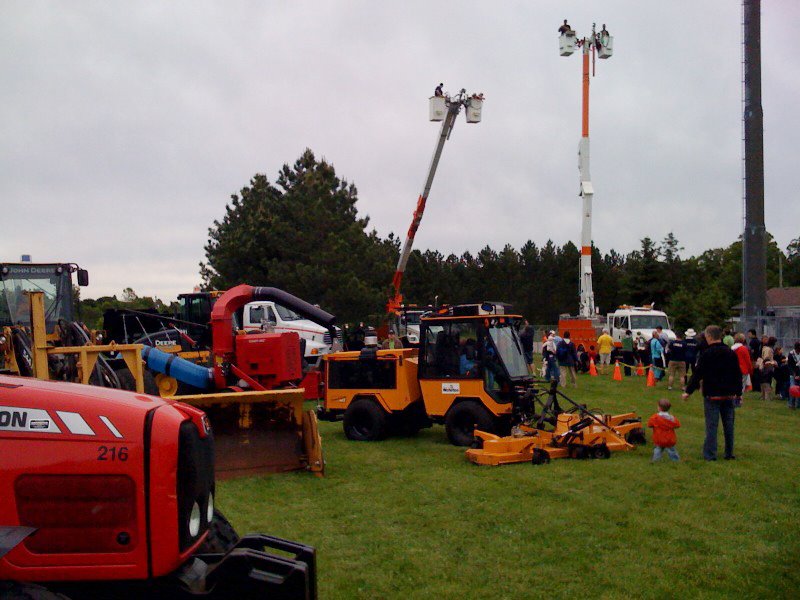
Every year, the City of Waterloo Public Works Service Centre has an open house. This year’s event was today, and my boys and I made the short trip to the centre this morning. It’s an amazing event at which kids can ride in a swing shovel or front-end loader and dig gravel, take a trip in a dump truck, go up high in the bucket of a hydro truck from Waterloo North Hydro, or explore a fire truck. There’s much more too. Add a few hot dogs for lunch and our morning was perfect.
From what I understand, the staff all volunteer their time to be there, and everyone seems to have fun. I’ve been taking my kids for years and I enjoy it immensely. Thanks to all of you who make this event happen — your effort and commitment makes living and working in Waterloo that much more fun.