Delivering overnight at Karos Health

Last Friday we had our second FedEx Day at Karos Health. Our first FedEx day was, to me, a prototype to see how the event would work at our company. That first try was a great success, and we resolved to do it again. While the details of our approach are slightly different than those at the company whose FedEx Days inspired us, Atlassian, our take on the concept is similar in spirit and purpose. (By the way, it’s called a FedEx Day, as you have to deliver something overnight.)

For our second event I had two goals in mind for my own activity. The first was to learn more about Ruby on Rails, a programming language and framework combination which I had begun investigating earlier in the week and with which I already had built an exceedingly simple application for creating and managing patient records. My second goal was to explore an approach to publishing documents as defined by IHE. I picked one of the simpler scenarios (use cases, in IHE parlance) to try to deliver on:

A patient in the emergency department has all her relevant available documents retrieved via 240 XDS transactions. As initial triage of the patient is done, an additional document regarding diagnostic results for this patient is registered in the XDS Document Registry. Currently, there is no way for the Emergency department to learn about the existence of this new information. With a publish/subscribe infrastructure, the initial query to the XDS Document Registry would be accompanied with a subscription request, as a result of which a notification would be sent to the 245 emergency department. The subscription will be terminated once the patient is no longer under the care of the emergency department’s institution.

— from “Unexpected Notification Use Case”, section 26.4.1 of IHE IT Infrastructure Technical Framework Supplement: Document Metadata Subscription (DSUB) (PDF)

Put another way, an emergency department physician has requested an imaging study, such as an MRI, for a patient. The requesting physician needs to see the results, provided as a document, as soon as they are made available by the radiologist who read at the study images. A notification alerts the physician that the result document is available.

Working with two of my Karos colleagues, I used Rails to put together a simple web app prototype focused on what a physician might see on a smartphone (an iPhone, for demo purposes, as that’s what I use every day) when receiving a notification that a document has been made available or updated. We used a simple script to push notifications into the prototype’s back end, which dutifully made them available to the different colleagues that we were demoing to. Each notification includes a link to the affected document, which can be viewed right away. Happily, the prototype worked well and I’m thoroughly enjoying Ruby on Rails so far.

It was fun to build and show the prototype, and fun to see all the other results that emerged from a day of directed play at Karos. We’re all looking forward to the next FedEx day at Karos.

UW co-op recruiting event for Karos Health

Today, from 5:00pm to 7:00pm, Karos Health will be hosting a recruiting event at the Bombshelter Pub on the University of Waterloo campus. We’re looking for co-op software developers to join us for the Fall 2011 term, and we’ll be at the Bomber in force to extoll the great benefits of working at Karos.

While I’m obviously biased to some extent, I do believe that Karos offers a great opportunity for a meaningful work term experience:

  • Interesting work on shipping products and/or research projects
  • A smart and experienced team to learn from
  • A great atmosphere

The event gives potential co-op employees a chance to talk with our development team, as well as with past and present co-op students. Drop by to chat, and to eat some of the free food that we’re providing. Hope to see you tonight!

My new/old wireless music player

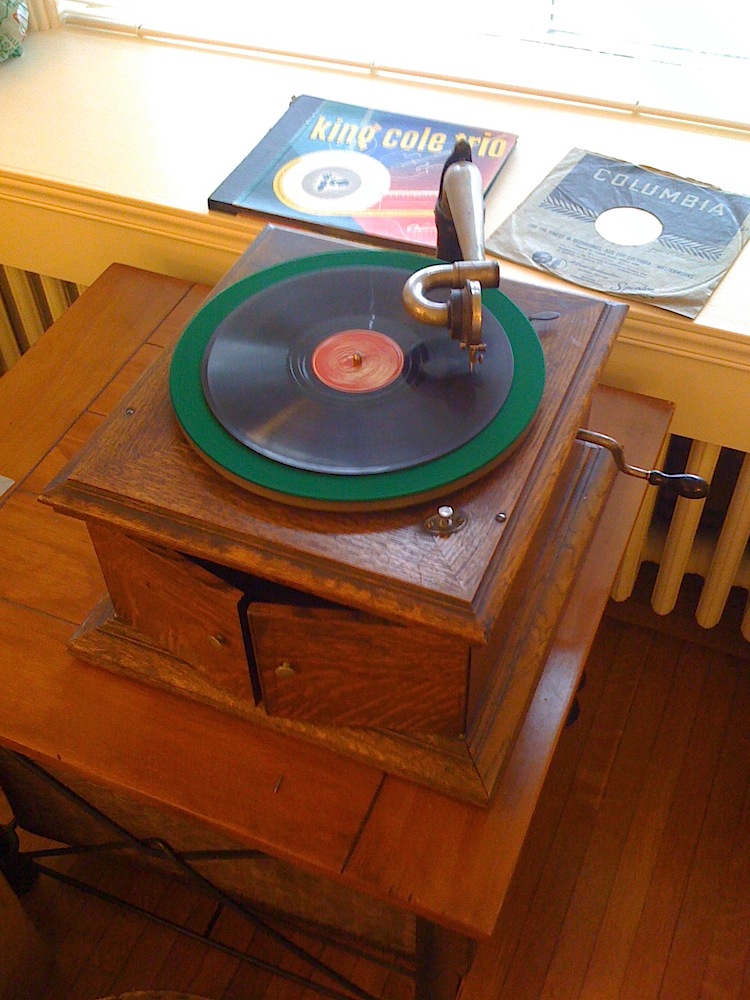
A Victrola playing a 78 RPM record

I recently acquired a couple of pieces of technology that are pretty much at opposite ends of their respective lifecycles.

One is an Apple iPad 2, which I’ll write about another time.

The other is a product that represents a technology that was enormously disruptive to the music industry of its time. This product, and others like it, enabled anyone to listen to recordings of music in their home — no need to go out to hear live music, or to learn to play an instrument and make your own music.

I now have a Victrola manufactured by the Victor Talking Machine Co. in 1917! I’ve had 78 RPM records in the house for several years now, some of them in album form, and it’s great to have a portable (well, luggable), wireless device to play them on. It doesn’t use electricity — just wind up the spring-driven turntable, put the needle down, and listen! What’s striking to me is that my new/old Victrola functions as well today as it did when it was first built almost a century ago; I doubt that my iPad 2 will be able to make that claim.

I already knew that the steel needles that pick up the sound from the grooves of a 78 RPM record should only be used once, as they wear out and a worn needle will damage records. One fascinating bit of information that I didn’t know previously, though, is that different needles will produce different tones when playing records. Needle selection is an important, and personal, choice when listening to these records, and I guess technology lovers of any era love tweaking and tuning their toys!

The prototype is done, let’s ramp up!

I wrote a little while back about the Research Entrepreneurship Accelerator Project at the University of Waterloo. The program got up and running for this past winter’s academic term, and saw a team of six students working on a prototype of an online marketplace in which artists and other content creators provide creative services for owners of Christie Digital MicroTiles. I was lucky to be able to work with the student team, as well as with the extended REAP leadership team.

Last Wednesday was the end-of-term presentation for the inaugural student REAP team, and I was happy to be able to see them present the results of their project to representatives for Christie. While I had seen the team’s work at various points during the project, the students still managed to surprise me. Their presentation was in the form of a play in which the team acted out the the scenarios that they had created in support of their design work. This was delightfully unexpected, but perhaps shouldn’t have been given that REAP is an initiative of the Arts faculty that happens to build cross-disciplinary teams.

Fittingly, the first REAP term was something of a prototype itself, and the lessons learned by everyone involved are already being applied as preparations move forward for the spring REAP term that starts in May. There are multiple projects lined up this time, with some interesting ideas to explore. The recruiting process is in its final stages — last night I had a chance to meet the student candidates for the next REAP teams —and I’m looking forward to supporting the new teams on their projects over the coming months.

We’ll be right back after this short break

I’m sure that most of you reading this will have seen Google’s Gmail Motion announcement on April 1, or one or more of the company’s many other foolish initiatives on that day. I love that they play this stuff straight, and that some of the jokes can be pretty ephemeral (like showing search results for “Helvetica” on that day using the widely-disparaged type face Comic Sans).

There are also hidden bits of whimsy in Google products that have been a round for a while, but which still make me smile. The question in search results for “recursion” is a favourite of mine. And when I occasionally look in my Gmail spam folder for missing messages, the ads that link to recipes that use Hormal Spam® are always welcome.

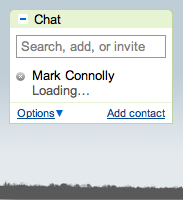
A screen showing Gmail chat attempting to connect

Sometimes the bits of whimsy are quite fleeting, but no less delightful when I notice them. I only recently discovered the messaging provided by Google’s chat functionality within Gmail. The company’s attention to details means that there are usually helpful status messages that explain what’s happening: “Loading…”

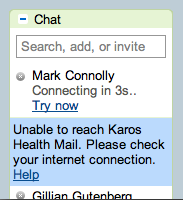
Screen image: Gmail connectivity state

When there’s an interruption in service, Chat will try to reconnect. Again, a message provides details on what’s happening: “Unable to reach Karos Health. Please check your Internet connection.”

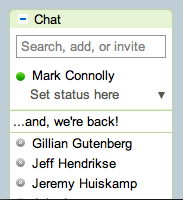
An were back

Of course, there’s also a message when the connection is restored. Evocative of a television talk show host announcing a return from a commercial break, the message “…and, we’re back!” is easy to miss, as it typically lasts only a few seconds. That means, though, that it’s also unobtrusive and it doesn’t get annoying. Lovely stuff!

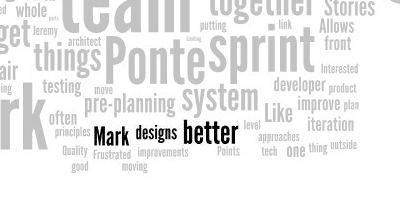
Randomly generated assessment: Mark designs better

At Karos Health we’re always trying to improve the way we work. To that end, we recently enjoyed some Agile coaching from Declan Whelan. Declan is well-known in the Waterloo Region and beyond for his deep knowledge and passion for all things Agile, and his presence Karos was a welcome one.

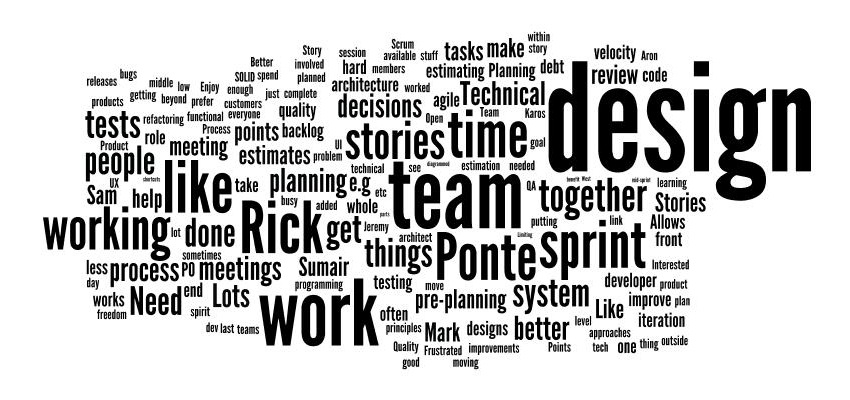
During a presentation/workshop, Declan shared some of his findings into his review of our development practices. One of the artifacts that he showed was a tag cloud created using Wordle, and which was based on notes that he took during one-on-one discussions with the team. I’m big fan of Wordle, for both the insights that it can provide into a source text as well as the aesthetic appeal.

In the case of Declan’s Wordle, an unexpected juxtaposition of words was particularly delightful for me. The first image shows the original image that Declan showed. The second image highlights the randomly-created, found phrase that caught my eye. Sometimes, little discoveries are a lot of fun.

A Wordle with various words including design, team, and work

(Declan’s Wordle)

A Wordle highting the words ‘Mark Designs Better’

(“Mark designs better”)

Research Entrepreneurship Acceleration Project

I’m involved with a great initiative at the University of Waterloo. The Research Entrepreneurship Acceleration Project (REAP) brings creative academic and private sector experts to explore new technologies – especially those involving interactivity, responsiveness, and digital display environments – in order to spark “research entrepreneurship.” The program hires a small team of students each term to work on a project. REAP is currently looking for students for the Spring term. All the details are below. Please spread the word, or apply if you’re interested.

Research Job for Spring 2011
The Research Entrepreneurship Acceleration Project (REAP) is looking for part-time, extracurricular paid student positions for Spring 2011. We are looking for students who are:

  • Creative
  • Entrepreneurial-minded or interested in learning how to be
  • Group-oriented
  • Results-oriented

We need students with any combination of these technical skills:

  • Graphic design
  • Machimina and game engine design
  • 3D graphic rendering or animation
  • Kinnect-style interactivity design

Benefits include:

  • Designing cool content and applications for leading edge technologies
  • Learning business, project management, group, and presentation skills
  • Expanding your professional resume

For the Spring 2011 term, we will be designing a proof of concept for a ‘Virtual Whisper Room.’ A virtual whisper room uses a game engine to create virtual environment in which avatars of customers interact and play with early-state product/application ideas too expensive – or to difficult – to design and render in the real world. It would combine graphics, machinima, a Kinnect-style technology and MicroTiles (Christie Digital’s newest display technology). Its main purpose is to show rather than tell – to allow people to experience new ideas so that designers and entrepreneurs can gain invaluable feedback during the early stages of prototyping ideas for new products. In order to be considered please:

  • send your resume to reap.uw at gmail dot com by Monday April 5th 2011.
  • reserve Monday April 11th 2011 7–9pm for a mandatory info session. More details about this night after your resume is received and reviewed.

Autonomy, Mastery, and Purpose at Karos Health

I’ve written before about a book by Dan Pink called Drive: The Surprising Truth About What Motivates. I’m a big fan of the book, and the three simple things that Pink says matter to people who are working in creative positions, or positions that don’t just involve repeating the same kinds of tasks again and again.

  • Autonomy. Ideally, over what you do, when you do it, who you do it with, and how you do it.
  • Mastery. Your abilities are finite, but infinitely improvable; improvement demands effort; and mastery can never be fully attained, which is part of the allure.
  • Purpose. Within an organization, use profits to reach purpose, emphasize more than just self-interest, and allow people to pursue purpose on their own terms.

My experience at Karos Health has been one that delivers on all three.

  • We practice Scrum and other Agile product development techniques, which gives a lot of autonomy for team members.
  • We’re always looking for ways to improve on what we do and how we do it, both as a company and as individuals.
  • People find a sense of purpose in different places, but health care is an area that delivers on that for me.

We’re looking for people to join the Karos team and help build great products and a great company. Have a look at the positions that we currently have open and give some thought to how you might fit in. Feel free to get in touch with me directly if you want to learn more, or just send in an application. It’s a fun and rewarding place to work.

March roars in like a lion

Last week was a bit of a blur as March roared in with the usual commitments at work keeping me busy and several extra-curricular activities added to the mix.

Wednesday started with Communitech’s Tech Leadership conference, an annual event that provided a great opportunity to meet people and engage in conversations. It also featured a pretty impressive lineup of speakers. I have to confess that Geoffrey Moore’s keynote presentation was a slight disappointment; while he’s a dynamic speaker, the material didn’t seem to add much in the way of new insights to what he has previously published. This particular crowd has to have been pretty familiar with the concepts of crossing the chasm.

The next session for me was with Scott Berkun, whose talk on the Myths of Innovation picked up on the theme of his book of the same name. I’ve heard Scott speak before and knew that I would enjoy his talk, and I did just that.

Following Scott’s talk, I travelled with him and my uxWaterloo conspirator Bob Barlow-Busch out to Quarry Integrated Communications in St. Jacobs, where Scott had agreed to do a special uxWaterloo lunch time talk. The theme was creative thinking hacks, and the format was completely open and driven by questions from the audience. It’s the same format that Scott used when he last spoke to the group, and it works well.

Wednesday evening was spent at Design Exchange Waterloo, where I acted as an industry panelist along with a couple of members of the local design community, Graham Whiting and Tammy teWinkel. The event featured enlightening presentations and lively conversations with many students. The hardest part was deciding which teams to give awards to, but after much deliberation we were able to arrive at decisions. The next event will likely be in the fall, and I’m looking forward to it.

Thursday was, of course, TEDxWaterloo. I hadn’t planned on attending, but some last minute schedule changes and the timely appearance of tickets changed that. As with last year’s inaugural event, it was a day of stimulating and inspiring presentations from some distinguished speakers. It was all terrific, but the most delightful surprise for me was Ben Grossman’s presentation on the hurdy gurdy, an ancient musical instrument with which Ben made some striking music while he was on stage. Moreover, between the two sets of talks, Ben provided wonderful background music that, for me, enhanced the many conversations that I had.

Sprinkled throughout the week were a few meetings with some of my fellow Ignite Waterloo organizers as we make plans for our next event. More news on that later.

The lion and the trackpad

Apple has released a version of the next version of Mac OS X, code-named Lion, to developers. That’s a fairly standard step on the release road for the company’s OS updates. In an article at AppleInsider, though, I noticed this interesting tidbit:

The new multi-touch gestures are designed to take advantage of the larger click TrackPads on more recent MacBook models, which could make them more difficult with older notebooks. Another strange quirk, people familiar with the developer preview said, is two-finger scrolling is reversed: to scroll down on a webpage in Safari, users must push up with their fingers, which is the opposite of how it works in Snow Leopard, but the same directly as scrolling on the iPad.

I’m pretty sure that nobody at Apple, or AppleInsider for that matter, reads this blog. Anyone who has read my previous post on scrolling from March of last year, though, will know that the change doesn’t feel like a strange quirk to me. It feels like the right direction to go, and Apple is clearly addressing the collision between old and new interaction paradigms.