After the split, what’s next?

Having left Primal Fusion, I’ve been giving some thought to what’s next. At the moment, I’m really in discovery mode — thinking about possibilities, talking to friends and colleagues, and generally trying to keep an open mind. It’s a liberating state to be in, as is the beginning of any new adventure, though it’s obviously not without its moments of uncertainty.

Having said that, I’m still pretty committed to living and working in the Waterloo area. There’s a great technology and startup community here with a lot of thoughtful, engaged, and passionate people who share their knowledge and experience through a variety of activities. And, Waterloo is also a fine place to live — as I’ve written previously, there are many reasons why my family and I enjoy living here.

Which brings me to what feels like quite an odd request.

I’d like to hear from anyone who would like to share any ideas on how I might think about what’s next. Let’s get together for coffee, or talk at a community event, or exchange email or tweets, whatever. I’m always impressed by the depth of knowledge, the wisdom, and the generosity of spirit that I’ve encountered in people in our community, and I want to find out whether its possible to tap into that at this stage in my adventure. It’s not quite crowd-sourcing a next career move; it’s more like seeing what I might learn by opening up the thinking process. For that matter, I’m also happy to share my own thoughts with anyone who has their own career questions and would like to chat.

For context, I hope that it’s clear from my various posts on this blog what my interests, skills, and experiences are (user experience, software products, startups, etc.).

Beyond this blog, I write in much shorter bursts on Twitter as @uxMark; reading my tweets there may or may provide more clarity! Connect with me there, or send me an email. My email address is my first name [at] connollydesign [dot] com.

Primal Fission

It’s been about a year since I started writing this blog. Many of the posts in that time have been about my experience at Primal Fusion. This post is one of those, but it’s a significant one as I’m now no longer with the company. From fusion to fission, so to speak.

Working at Primal Fusion has been a great experience. I was able to work on challenging projects and did so with with smart and devoted people, many of whom are still with the company.

I’d like to extend my thanks to Bob Barlow-Busch, who brought me to Primal Fusion, and to Shane O’Neil, who gave me a team to run. It was wonderful to work with them both. I’d also like to say thanks to my team, working with whom has been a great gift and a privilege for me. I learned something from each of them, and as a team we did great things. I’m proud of what we accomplished and will miss working with them all. If you’re reading this, guys, thanks for everything. Finally, thanks to all the other Primates who have made the Primal Fusion what it is and made my time there so meaningful.

Best of luck to all of you.

March roars in like a lion with Ignite Waterloo 2

Last week’s TEDxWaterloo event will be a hard act to follow, as it was a resounding success enjoyed by all.

Nevertheless, this week sees the second Ignite Waterloo event happening on Wednesday at the Children’s Museum. The first event was held last November and a fine time was had by all. The upcoming second event promises to be every bit as engaging and thought-provoking. I’m looking forward to the talks and the conversations.

Prior to Ignite Waterloo, the March edition of StartupDrinksWaterloo in happening on Tuesday night at McMullan’s in Waterloo. I’ve managed to attend every edition except the inaugural one, and have enjoyed them all. I’m once again looking forward to the beer and conversations!

TEDxWaterloo knocks it out of the park

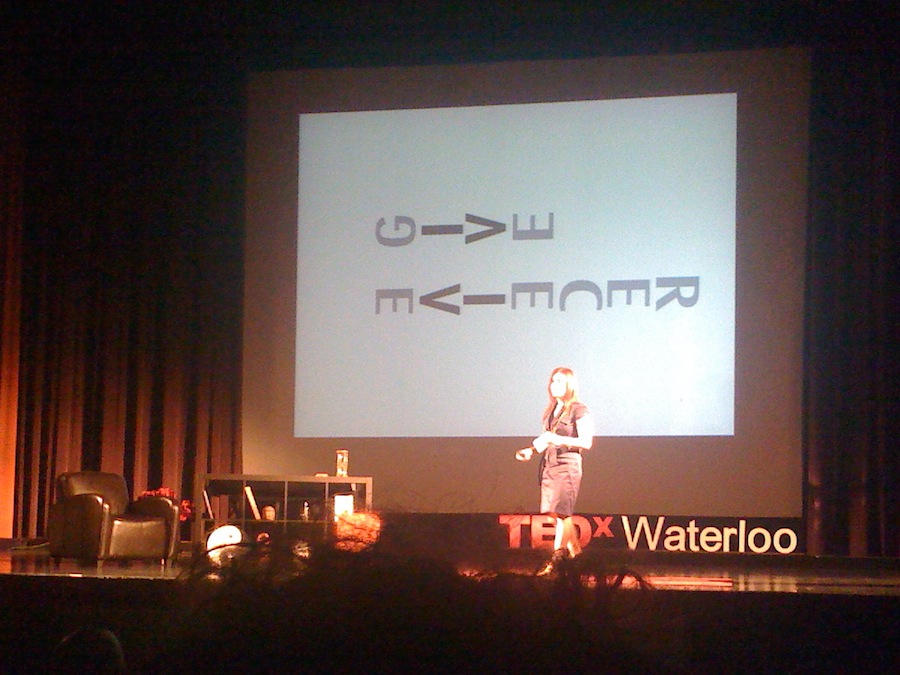
A presenter onstage at TEDxWaterloo

Wow! That was amazing!

TEDxWaterloo, on Thursday February 25, was even better than my already high hopes for it had led me to expect. The ambience at the Gig Theatre was great, the speakers were inspiring and the conversations I had were a treat. While the topics and styles for the talks were diverse they all related, even if loosely, to the overall theme of the event, Tomorrow Started Yesterday. While I got something out of each talk, highlights for me included Terry O’Reilly’s musings on friction, Paul Saltzman’s highly personal yet somehow epic reflections on life, Caroline Disler’s dissection of the foundations of what we call Western Civilization, and Madhur Anand’s exploration of the meaning of green.

Conversations were great too. I ended up chatting a fair amount with a student from the university of Waterloo about Bruce Springsteen, of all things. He’s a huge a fan, and said that he had never really met another fan before. I never expected to be weighing the merits of the 1978 Cleveland Agora show at TEDxWaterloo, but that’s the magic of the encounters that the event facilitates!

There were a few glitches, including a late start due to technical problems with getting the streaming video working and a crowded food area during the first break. These, for me, felt minor and in no way diminished the overall experience of the event. My only regret is that I didn’t make it to the after-party.

I left the theatre energized, enthused, and engaged. Congratulations, and thanks, to the folks who put this on. Outstanding!

Finally, I’ll leave Amy Krouse Rosenthal with the last word or, more precisely, the last seven words to wrap up this report:

Make the most of your time here.

UX guerrillas in our midst

This month’s meeting of the User Experience Group of Waterloo Region is a workshop presented by my friend and colleague Blair Nonnecke. It’s a Guerrilla Usability Workshop, and it will involve group work and plenty of opportunity to learn and share. If you’ve been out before, you’ll already know that the discussions can be quite rewarding. If you haven’t been out, or haven’t attended in a while, come on out and see what you’ve been missing.

It’s this Thursday February 18 at 5:30pm in the friendly confines of the Accelerator Centre. Please be sure to RSVP if you intend to be there, but even if you don’t get a chance to do so, come on out anyway.

Ignite Waterloo is coming back on March 3

Time flies. It’s already been over two months since the first Ignite Waterloo event last November 25. The second event is scheduled for March 3, 2010. Like the first event, it will be held at the Children’s Museum in Kitchener, and will feature 16 talks on a wide range of topics. Eight speakers have been announced already, with the rest to be revealed soon.

Registration is open, but tickets appear to be moving fast — 100 gone as I write this — so head over to the registration page if you want to attend.

The Apple iPad and ubiquitous computing

One of the things that strikes me about the iPad that Apple introduced last week is the name. It’s attracted a fair amount of derision and ridicule, just as the iPhone has drawn flak in some circles for its being such a closed, tightly controlled system.

(I should make it clear at this point that I myself love Apple’s products and have been using them for two decades.)

To me, though, the iPad name (and, by extension, the whole iPad/iPhone family of products) harkens back to work done at Xerox PARC in the late 1980s and early 1990s on ubiquitous computing. That term was coined by the late Mark Weiser and it’s an area that he helped define. Here’s a great prediction from Wesier in 1988:

For thirty years most interface design, and most computer design, has been headed down the path of the “dramatic” machine. Its highest ideal is to make a computer so exciting, so wonderful, so interesting, that we never want to be without it. A less-traveled path I call the “invisible”; its highest ideal is to make a computer so imbedded, so fitting, so natural, that we use it without even thinking about it. (I have also called this notion “Ubiquitous Computing”, and have placed its origins in post-modernism.) I believe that in the next twenty years the second path will come to dominate. But this will not be easy; very little of our current systems infrastructure will survive. We have been building versions of the infrastructure-to-come at PARC for the past four years, in the form of inch-, foot-, and yard-sized computers we call Tabs, Pads, and Boards. Our prototypes have sometimes succeeded, but more often failed to be invisible. From what we have learned, we are now exploring some new directions for ubicomp, including the famous “dangling string” display.

Note that Tabs were envisioned as quite-small computing devices, much like the current iPhone or iPod Touch. Pads were somewhat larger, much like the new iPad. Boards were larger-still, wall-mounted smart boards, or perhaps like today’s Microsoft Surface. 20-plus years later, Apple is delivering on the vision of ubiquitous computing with an ever-evolving suite of products and services. (Many observers also point back to Apple’s Newton MessagePad of the early 1990s as an ancestor of the current Apple products.)

My take, and it’s not a particularly clever or original one, is that the iPad, like the iPhone before it, isn’t meant to be seen as a general purpose computer. It’s an appliance for which the user doesn’t need to be aware of what’s going on under the hood — the computer is invisible. iPad users just get stuff done anywhere and at any time. Moreover, iPad is part of a larger Apple ecosystem that includes the iPhone and traditional Macs, but also a suite of cloud-hosted services that Apple is long-rumoured to have been working on.

The better these devices can deliver services invisibly and ubiquitously, the better the experience will be for many people. Not all people, of course — many will still opt for more open systems and solutions. There will always be other options available, from companies such as Google, but Apple’s direction is an important one.

That was a fine night in Guelph

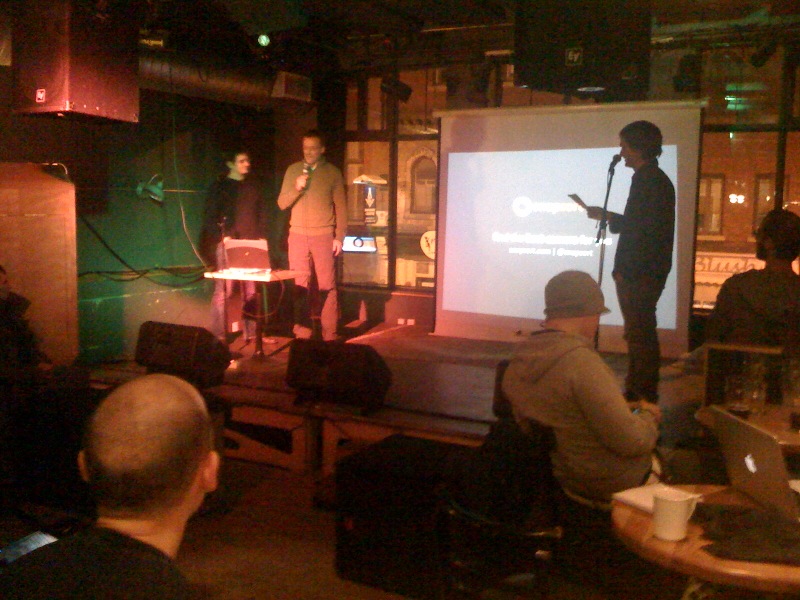
Alex Black demos his new product Snapsort onstage

DemoCampGuelph has a great combination of demos, atmosphere, conversations, and just plain fun. The 12th edition this past Wednesday had all that, and made for a warm event on a cold January night. As usual, the event was well-organized and inspiring.

At the start of the evening I spent some time planning the next UX Group meeting over dinner with a friend and colleague who will be leading a workshop on guerrilla usability. Should be a great event — more details to come in the next few days.

DemoCampGuelph proper got off to a great start with a talk by Tara Hunt about the social world. Good stuff. My takeaway? Don’t be an evil robot!

The demos were entertaining for a variety of reasons. Harry Scanlan’s demo-as-standup-comedy (or is it standup-comedy-as-demo?) is just as funny as it was the first time I saw him present/perform. On a more serious side, I particularly enjoyed seeing my former Primal Fusion colleague Alex Black demo his new product Snapsort. That’s him in the accompanying photo, responding to Brydon’s introductory questions.

The only downside of the night for me was that I couldn’t stay longer — family commitments took me home sooner than I would have liked.

Shopping in the neighbourhood

There’s a lot to like about living and working in Waterloo. In previous posts I’ve commented on non-commercial aspects of my community. Today, following an exciting new opening last week, I feel compelled to write about a few independent businesses that happen to be within walking distance of my home and that I’ve been patronizing for many years. All of them add to my quality of life in Waterloo, and I’m grateful that they’re here.

Vincenzo’s, a lovely grocery store, recently opened their brand new location in the historic Bauer building, and I discovered on a recent visit that it really is quite wonderful. I’ve been shopping at Vincenzo’s for a very long time — I was first introduced to the store by a friend while I was attending university. At that time it was in a small house on Bridgeport Road in Waterloo and wasn’t yet called Vincenzo’s. My wife and I continued to enjoy the delights of the store when they moved to a larger location on Belmont Avenue in the early 1990s. The new location is even better, and I’m looking forward to shopping their regularly. If the sausages that we had for dinner this weekend are any indication, the newly added Bauer Butcher will be a great hit.

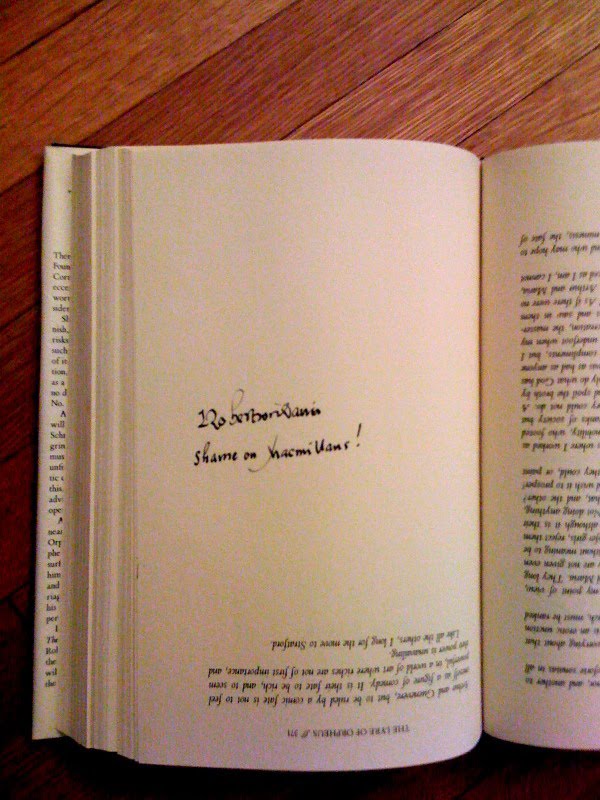
Inscription in book from Robertson Davies

On another front, Words Worth Books is also a longstanding presence in the community. Over the years they’ve weathered the arrival of big box bookstores and internet shopping, and continue to provide a passionately local and literate alternative to those other shopping options. I’ve lost track of the number of times that I’ve gone with a staff recommendation when buying there over the years. I’ve also enjoyed readings by the many authors that Words Worth has brought to town, and look forward to many more. One, in particular, stands out. The late Robertson Davies, a celebrated Canadian author, was here to to promote his most recent book, The Lyre of Orpheus. My wife had brought her copy of the book, which I had previously given to her for her birthday, in the hope of getting it autographed. While standing in the autograph line after the event, my wife joked with Words Worth co-owner Tricia Siemens about a flaw in her copy of the book — some of the pages had been bound upside down. Tricia wanted to replace it, but my wife didn’t want to bother, and Mr. Davies heard the discussion. He took the book and examined it, before inscribing the great message “Robertson Davies Shame on Macmillans!’

Last for today, but certainly not least, is Generation X Video and Media. Mike and his crew have been a reliable source of fine videos, books, magazines, and odd collectible toys for over a decade now. The store was initially located in a house on Regina Street, and later moved into the Regina Commons location where they can be found today. We’ve been getting movies there from the very beginning, as my wife found and explored the store before they were even officially open! It’s a great place where everyone cares about movies. I’ve never hesitated to walk in and ask Mike or Chris “What should I watch?” and neither has ever steered me wrong.

While every city has it’s own unique independent businesses, these are three that make Waterloo special.

Primal Fusion a hit at EpCon

Peter Sweeney presenting at EpCon

In my earlier post about January events, I forgot to mention EpCon, organized by and for students from the University of Waterloo and which ran this past Friday and Saturday. Primal Fusion was one of the companies that participated, and I was lucky enough to spend some time at the conference.

I started off late Friday afternoon when I joined three of my colleagues at a booth where we evangelized Primal Fusion to interested visitors. And there were a large number of interested visitors. In a room that featured representation from giants like Google, Microsoft, and Facebook, it was gratifying to see how many folks were interested in what we’re doing. Many of them were also interested in joining us for a co-op work term.

On Saturday morning, Primal Fusion founder Peter Sweeney gave a talk in a session that was, again, well-attended. The engaged and enthusiastic audience seemed genuinely interested in hearing Peter’s ideas about the industrialization of the Web. At the end, he gave a demonstration of a Website Generator, which is currently in Primal Labs (and which I had shown in an earlier form at StartupCampWaterloo last fall). The demonstration was well-received and, despite having a time slot right before lunch, many folks from the audience wanted to chat with Peter after his talk. It was, by any measure, a fine morning.

EpCon looks like it was a great success. Congratulations to the organizers for a job well done. EpCon was certainly well worth the visit for Primal Fusion.